
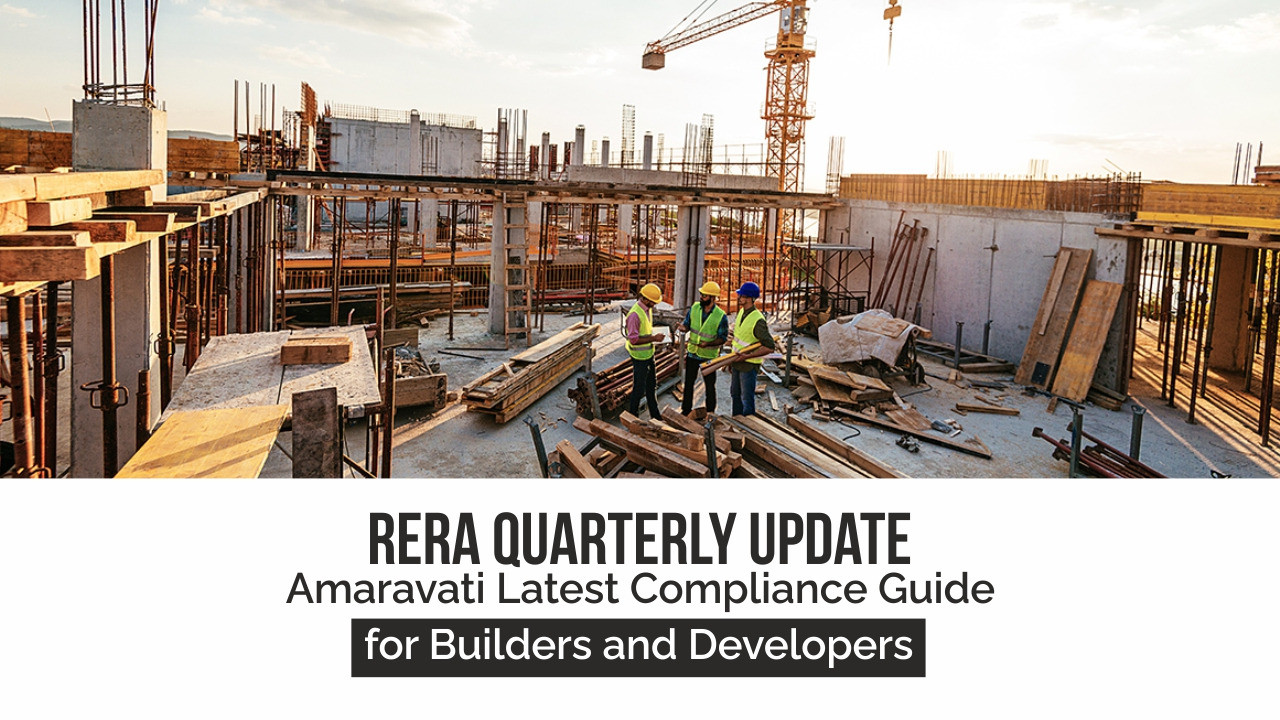
A developer running a 72-unit apartment project near Amaravati's Thullur area had his RERA registration in place, his project launched, and sales moving at a reasonable pace. By the end of the second quarter after launch, he had collected over Rs. 1.8 crore from buyers. But he had not filed a single quarterly update on the AP RERA portal. No construction progress report. No fund utilization statement. Nothing.
A buyer who had paid Rs. 12 lakhs checked the portal six months after booking and saw no updates whatsoever. He filed a complaint with AP RERA. The authority issued a show-cause notice. The developer scrambled to file backdated updates, which the portal does not accept cleanly. He ended up paying a penalty equivalent to 50% of his original registration fee for the missed quarters and spent three weeks in back-and-forth with the authority while his sales team answered uncomfortable buyer questions.
The registration was never the issue. The compliance after registration was. That gap is where most developers in Amaravati trip up, and it is entirely avoidable with a basic compliance calendar and the right support in place.
What Does the Quarterly Update Actually Require You to Submit?
Under Section 11(1) of the Real Estate (Regulation and Development) Act, 2016, every registered project promoter must submit a quarterly progress report to the RERA authority at the end of each quarter. For AP RERA, this requirement applies to all registered projects in Amaravati and across Andhra Pradesh without exception.
Each RERA quarterly update Amaravati filing must contain three core certified documents, referred to collectively as the RERA Return:
● Form 1: Architect Certificate confirming the percentage of construction completed during the quarter, with supporting site photographs
● Form 2: Engineer Certificate validating the structural work completed and certifying the corresponding stage of construction
● Form 3: CA Certificate showing total funds collected from buyers that quarter, how those funds were utilized, and the current balance in the project escrow account
Beyond these three certificates, the developer must also update floor-wise construction status on the portal, with photographs as proof of work done. The number of flats sold, currently under booking, and available for fresh sales must also be updated in the project's live dashboard on the AP RERA portal.
When Does the Filing Deadline Fall?
AP RERA requires promoters to submit quarterly updates within seven days from the expiry of each quarter. The four quarters follow the standard calendar year:
● April to June quarter: filing due by July 7
● July to September quarter: filing due by October 7
● October to December quarter: filing due by January 7
● January to March quarter: filing due by April 7
AP RERA has in the past issued circulars directing all promoters to treat these filings as a strict duty, noting that non-submission within the stipulated time is a direct violation of the Act. The authority has also, in certain quarters, extended the deadline for specific periods, as was the case with the July-September 2025 quarter, where an extension was formally communicated. However, waiting for an extension to be announced before preparing your filing is a risky approach. Extensions are discretionary, not guaranteed.
Mark these four dates at the start of every year in your compliance calendar. The preparation work, getting the architect, engineer, and CA certificates aligned and ready, takes at least a week to ten days when everyone is available. Starting the process on the deadline date is how penalties happen.
What does the Penalty Structure Look Like?
AP RERA's notification on late quarterly compliance filing makes the penalty structure explicit. For the most recent quarters where the authority has formalized the penalty table, the structure works as follows:
● Filing within the standard window after the quarter ends: no penalty
● Filing between 23 days and 40 days after quarter end: 50% of the registration fee originally paid at the time of project registration
● Filing between 41 days and 60 days after quarter end: 100% of the original registration fee
For developers who registered large projects and paid higher registration fees, this penalty is not trivial. A developer who paid Rs. 80,000 in registration fees and misses the quarterly window by 45 days ends up paying Rs. 80,000 in penalty for a single quarter's late filing.
Beyond quarterly filing penalties, Section 61 of the RERA Act states that any contravention of the Act's provisions can attract a penalty of up to 5% of the estimated project cost as determined by the authority. A persistent pattern of non-compliance, or missing multiple consecutive quarters, puts a developer in a territory where the authority can escalate action significantly.
The Escrow Account and Why It Connects Directly to Quarterly Filings
Most developers understand that 70% of all buyer collections must go into a dedicated project escrow account. What some miss is that this escrow account cannot be freely drawn from whenever the developer needs funds. Every withdrawal requires the submission of documents to the bank that state the percentage of construction completed, which maps directly to what the architect and engineer certificates in the quarterly return are certifying.
This means the quarterly filing and the escrow withdrawal are linked. If the developer does not file the RERA quarterly update for Amaravati on time, the supporting certificates needed for the escrow withdrawal are also not in order. That creates a cash flow problem mid-construction that compounds the compliance problem.
The practical discipline this requires is straightforward: at the end of each quarter, get the architect to inspect the site and issue Form 1, the engineer to certify Form 2, and the CA to prepare Form 3 based on the actual bank statement of the escrow account. These three documents need to align with each other. If the architect certifies 35% completion but the CA's statement shows fund utilization inconsistent with 35% of the work, the filing will attract queries from the authority.
What Projects Are Exempt From Quarterly Updates
AP RERA has issued specific conditions under which a registered project can be exempt from submitting quarterly updates. These exemptions apply to residential, commercial, and mixed-development projects that meet all of the following criteria:
● All units in the project have been sold
● Construction has been fully completed
● An occupancy certificate has been obtained from the competent local authority
● All buyer handovers have been completed, and possession letters have been issued
Until all four conditions are met simultaneously, the quarterly filing obligation continues. A project where construction is complete but one or two units are still unsold must continue filing. A project where all units are sold but possession has not been given must also continue filing. The exemption kicks in only when the project is fully closed from a regulatory and commercial standpoint.
For developers managing multiple registered projects in Amaravati, this means each project runs its own separate compliance clock. A project that met all four conditions in September is exempt from Q3 onwards. Another project, still mid-construction, keeps filing every quarter regardless.
How a Missed or Incorrect Filing Affects Buyer Trust
The RERA quarterly update Amaravati filing is not just a regulatory obligation sitting in a government database. It is publicly visible on the AP RERA portal. Any buyer, at any point, can open the project listing and see whether quarterly updates have been filed on time, what the construction status shows, and whether the filed progress matches the possession timeline the developer promised at the time of booking.
A project that shows two or three consecutive quarters with no update filed, or with the construction percentage stuck at the same number despite time passing, raises immediate red flags for buyers reviewing the portal. Buyers who have already paid installments and see no construction progress reported will send legal notices. Buyers considering a purchase in the project will walk away.
This dynamic is particularly sharp in Amaravati, where buyers from outside the city, including NRIs and buyers relocating from Hyderabad or Bengaluru, depend entirely on the portal to track their investment. They cannot visit the site every month. The quarterly update is their primary window into the project's progress. A developer who keeps these updates clean and current is essentially running a transparent communication channel with every buyer simultaneously, without a single additional sales or customer service effort.
What Good Quarterly Filing Looks Like in Practice?
A developer managing a 96-unit apartment project across three towers in Amaravati's Tadepalle stretch had a simple system that worked well. At the start of the third month of each quarter, the project site engineer would photograph every floor and document the current construction stage in writing. The architect would visit on a fixed date in the last week of the quarter and certify Form 1 based on that documentation. The engineer would certify Form 2 the same day. The CA would prepare Form 3 within three working days of receiving the escrow account statement from the bank.
All three documents were handed to the consultant handling the RERA quarterly update, Amaravati filings, by the 28th of the last month of the quarter. The consultant would upload everything to the AP RERA portal before the 5th of the following month, two days before the official deadline.
That two-day buffer is not excessive caution. Portal technical issues, last-minute certificate corrections, and bank statement delays are real occurrences. Filing on the 6th or 7th,h when the deadline is the 7th, leaves no room for anything to go wrong.
When to Bring in a Compliance Consultant?
Developers managing one project with an in-house accounts team sometimes handle quarterly filings themselves. But when a developer is running two or more registered projects simultaneously in Amaravati, the volume of certificates, portal uploads, and deadline tracking becomes difficult to manage internally without dedicated attention.
A compliance consultant handling RERA quarterly updates will maintain a project-wise filing calendar, coordinate with your architect, engineer, and CA in advance of each deadline, and handle the actual portal upload. More importantly, they will check that the three certificates align before submitting, catching discrepancies between the architect's completion percentage and the CA's fund utilization figures before AP RERA sees them.
The cost of a compliance consultant for quarterly filings is significantly lower than the penalty for missing a single quarter on a medium-to-large registered project. For developers with projects priced at the scale common in Amaravati's capital region, where registration fees themselves can run into lakhs, that calculation is straightforward.
Keeping the RERA quarterly update Amaravati filing current, accurate, and on time is not just about avoiding penalties. It is how a developer's public compliance record stays clean, how buyer trust is maintained without extra communication effort, and how the next project launch starts with a credible track record already on file with the authority.